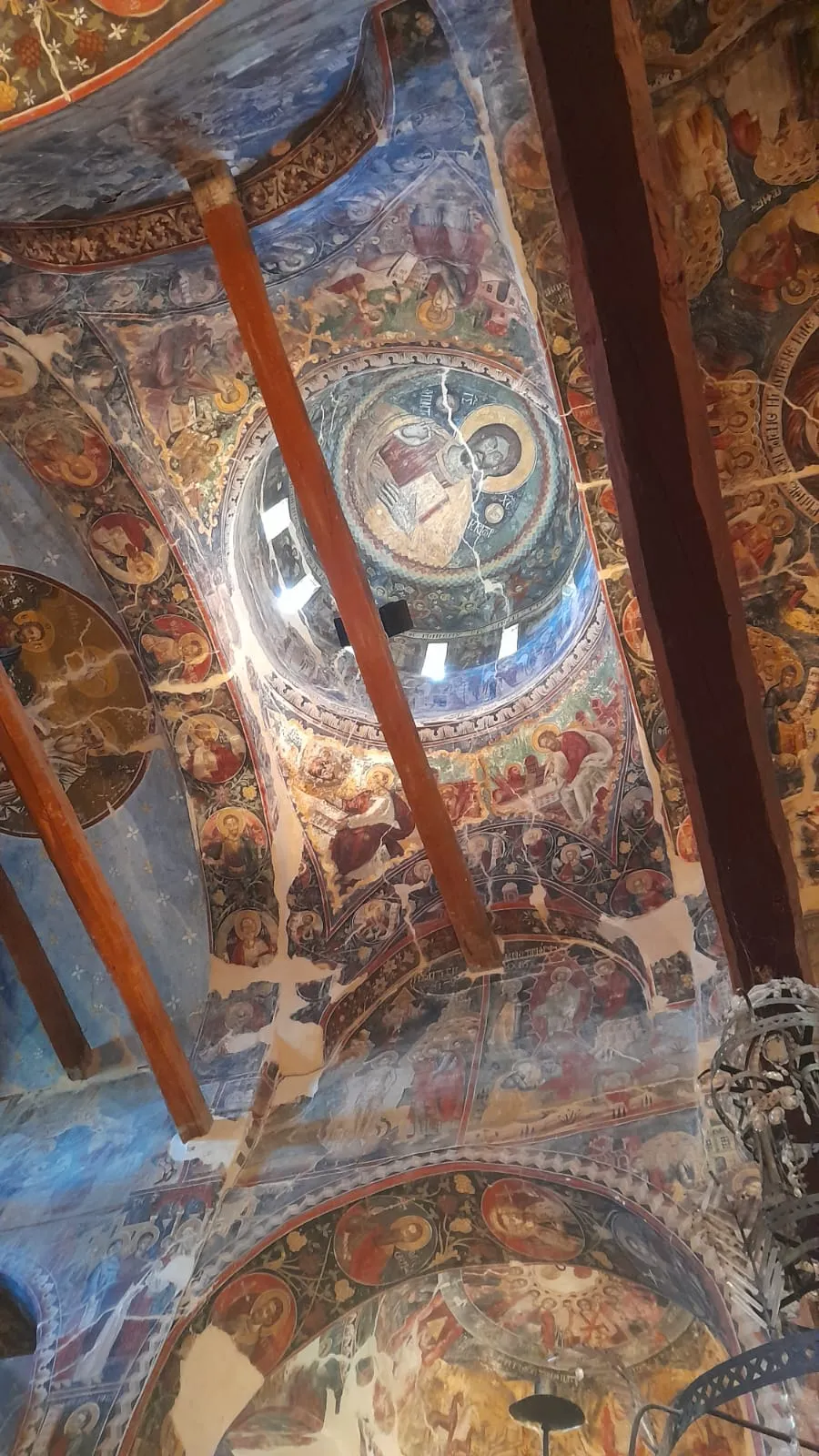
Leusa Church (Kisha e Shën Marisë) is an 18th-century Orthodox church perched on a hillside above Leusa village, reached via a 30-45 minute uphill walk from Përmet's town center along an original cobblestone path. Inside, vibrant Byzantine-style frescoes and a hand-carved walnut-wood iconostasis have survived largely untouched for over 250 years. The hike itself is one of the best vantage points in the area for sweeping views over the Përmet valley, the Vjosa River, and the Vjosa Wild River National Park beyond. Entry is free, though donations are welcome, and modest dress is expected inside the active church.
Hidden in the lush mountain slopes just above Përmet lies the historic village of Leusa, home to one of Albania's most remarkable cultural treasures: The Church of St. Mary (Kisha e Shën Marisë). Built in the 18th century, this Orthodox church is famous for its completely preserved, vibrant frescoes and intricate wood carvings.
The Cobblestone Hike
Part of the magic of visiting Leusa Church is the journey to get there. Because the village sits on a steep incline above Përmet, it is best accessed on foot. The hike begins directly from the city center and follows a centuries-old, original cobblestone path that winds its way up the mountain.
The walk takes approximately 30 to 45 minutes and leads you through peaceful canopies of walnut and fig trees. As you ascend, you are rewarded with increasingly beautiful, panoramic views of the entire Përmet valley and the Vjosa River below.
Untouched 18th-Century Frescoes
When you arrive at the church courtyard, the exterior appears humble, built with traditional local stone. However, stepping inside reveals a breathtaking display of Orthodox art. The interior walls, vaulted ceilings, and arches are completely covered in vibrant, deeply pigmented frescoes painted by masters in the 18th century.
Remarkably, this church escaped the waves of religious destruction during Albania's dictatorial era. Locals often attribute its survival to the sheer beauty of the artwork and its slightly remote location. Alongside the paintings, the church features a spectacular iconostasis (the altar screen) hand-carved from solid walnut wood, showcasing incredible craftsmanship that took years to complete.
A Peaceful Retreat
The church courtyard is surrounded by a large stone wall and features a natural cold-water spring. It is a place of profound silence and peace, offering a perfect moment of reflection after the uphill hike. Visitors often sit in the shade of the massive cypress trees, enjoying the cool mountain breeze before making the descent back to the city.
Visiting Etiquette and Access
Leusa Church is an active Orthodox place of worship, so modest dress (covered shoulders and knees) is appreciated and visitors should remove hats before entering. The church isn't always unlocked — if you arrive and find it closed, a caretaker from the nearby village can often open it on request, so it's worth asking locally in Përmet before setting out if seeing the interior frescoes is a priority. Photography is generally permitted, but flash should be avoided to help preserve the centuries-old paintings.
How to Get There
Leusa village sits directly above Përmet's town center, and the church is reached via a marked cobblestone path that begins just a few minutes' walk from the main square — no car is needed for the hike itself. If you'd rather not climb, a narrow mountain road also connects Përmet to Leusa village, used by our 4x4 Mountain Safari tours, though the final approach to the church is on foot regardless. For visitors without their own transport, the route to Leusa is included as a stop on the guided Hiking Tour, which adds historic churches and viewpoints along the same trail network above the Vjosa Valley.
Best Time to Visit
Leusa Church is open year-round, but the experience changes dramatically with the seasons. Spring (April-June) brings wildflowers and walnut and fig trees in fresh leaf along the trail, with mild temperatures ideal for the climb. Summer offers the clearest long-distance views over the Vjosa River and the Vjosa Wild River National Park, including the forested ridges toward Sopoti Waterfall across the valley, though the exposed upper switchbacks can get hot, so an early-morning start is best. Autumn brings golden foliage and harvest season in the valley below, while winter visits are possible but the cobblestone path can be slippery after rain or snow — sturdy footwear is essential outside the dry months.
What to Bring
Pack light but practically for the climb to Leusa Church. Sturdy walking shoes or light hiking boots are essential — the cobblestone path is uneven and can be slippery when wet. Bring water, since there are no shops along the route (though the church courtyard has a natural cold-water spring). A hat and sun protection are useful on the more exposed sections, and a light jacket is worth carrying even in summer, as the breeze picks up near the top. Because the church is an active place of worship, pack a scarf or light layer to cover shoulders if you're wearing sleeveless clothing, and bring small change for a donation. A camera is worthwhile for both the frescoes and the views back over Përmet, where the City Stone rises above the rooftops with the Vjosa River beyond.
Nearby Attractions
Leusa Church's hillside position makes it a natural gateway to the wider Vjosa Wild River National Park landscape — from the church courtyard, the Vjosa River is visible winding through the valley below, with the wooded slopes of the National Park rising on the far bank. Back in Përmet, the City Stone (Guri i Qytetit) offers a second panoramic viewpoint over the same river, just a short walk from the town center. For Albania's iconic spoon-sweet tradition, stop by a family workshop for Gliko tasting. Hikers continuing further afield can combine Leusa with Sopoti Waterfall, another trail that climbs from the Vjosa valley floor into the National Park's forested terrain, on the same multi-day itinerary.