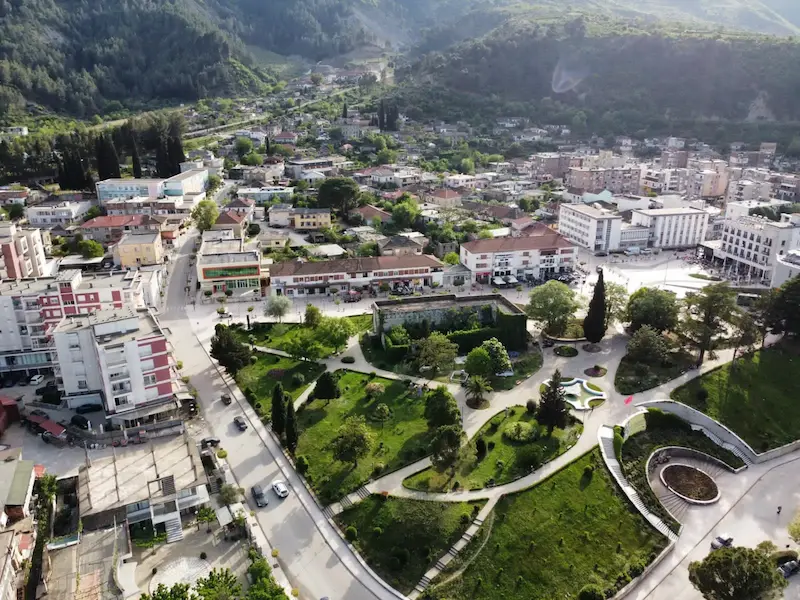
Guri i Qytetit (The City Stone) is a 42-meter limestone monolith standing in the center of Përmet on the banks of the Vjosa River, southern Albania. Free to visit and reachable by a 5-10 minute climb up carved stone steps from the town square, its summit offers 360-degree panoramic views over Përmet's rooftops, the Vjosa Valley, and the Dhëmbel mountains. According to legend, the town was named after Premt, a 15th-century leader who leapt from the rock rather than surrender to Ottoman forces. Best visited at sunset for golden-hour photos.
Dominating the skyline of Përmet is a massive, striking geological formation known as Guri i Qytetit, or "The City Stone." Standing at 42 meters tall right along the banks of the Vjosa River, it is the undisputed symbol of the city and a must-visit attraction for anyone traveling to southern Albania.
A Geological Marvel
Geologists believe that Guri i Qytetit broke away from the nearby Trebeshina mountain range thousands of years ago, tumbling down and lodging itself perfectly in the river valley. Today, it stands as a solitary monolith in the center of town. Covering an area of roughly 650 square meters, this massive limestone rock has watched over Përmet for millennia, serving as both a natural fortification and a spiritual centerpiece for the locals.
The Legend of Premt
You cannot talk about the City Stone without mentioning the famous legend that gave the town its name. According to local folklore, during the 15th century, the town was ruled by a noble leader named Premt. When the powerful Ottoman Empire invaded the region, the town was besieged.
Refusing to surrender to the invading forces, Premt made a heroic and tragic decision. Rather than be captured, he threw himself from the top of the City Stone. In honor of his bravery and ultimate sacrifice, the town was named Përmet in his memory. Today, the stone stands as a monument to that historic resilience.
Climbing to the Top
While the sheer cliff faces of the rock look intimidating from the town square, reaching the top is actually a very accessible experience. A series of carved stone steps wind safely up the back of the rock, allowing visitors of moderate fitness to reach the summit in under 10 minutes.
At the top, you will discover the ancient ruins of a small fortification and, more importantly, a breathtaking 360-degree panoramic view. From this vantage point, you can look down over the red-tiled roofs of the "City of Roses," gaze out at the winding turquoise waters of the wild Vjosa River, and admire the towering peaks of the Dhëmbel mountains. It is undoubtedly the best photo spot in the city.
Përmet's Literary Legacy: The Çajupi Connection
Climbing Guri i Qytetit also connects visitors to Përmet's identity as the hometown of Andon Zako Çajupi, one of Albania's most celebrated poets and a key figure of the 19th-century National Renaissance (Rilindja) movement. Çajupi's verses often evoke the Vjosa Valley and the rugged peaks visible from the City Stone's summit, and a small monument in Përmet's town center honors him — making the climb a fitting starting point for exploring the town's cultural heritage alongside its dramatic geology.
How to Get There
Guri i Qytetit rises directly above Përmet's town center, making it the easiest of the area's natural landmarks to reach — no car is needed if you're already staying in town. Përmet itself sits about 100 km (2-2.5 hours) from Gjirokastër, around 60 km (1.5 hours) from Tepelenë, and roughly 200 km (3.5-4 hours) from Tirana via the SH75 and SH4 roads through the Vjosa Valley. From the main square or riverside promenade, simply follow signs toward the base of the rock, where free parking and the carved stone staircase to the summit begin.
Best Time to Visit
The City Stone can be climbed year-round, but sunset offers the most rewarding light, when the Vjosa River below turns gold and the surrounding peaks glow pink. Spring and autumn bring mild temperatures ideal for the short climb, while midsummer afternoons can be hot on the exposed stone steps — early morning or evening visits are more comfortable. The rock is illuminated at night, making it a striking sight from town, though the climb itself should be done in daylight. Avoid the steps in icy or wet winter conditions, as the carved stone can become slippery.
What to Bring
Because the climb takes only 5-10 minutes on stone steps, no special gear is needed — comfortable walking shoes are enough. Bring a camera or phone for the panoramic summit views, and a water bottle if visiting during the heat of summer. Sun hats and sunscreen are useful for sunset visits in warmer months, since the upper steps are largely exposed. There's no entrance fee or facilities at the summit, so plan to grab a coffee or gliko in Përmet's town center before or after the climb.
Nearby Attractions
Guri i Qytetit sits at the heart of Përmet, within walking distance of traditional gliko tasting houses along the riverside promenade. The hilltop Leusa Church, with Byzantine frescoes and views over the Vjosa Valley, is a short drive away. For a full day combining the town with the surrounding Vjosa Wild River National Park, head to Bënja Thermal Baths and Lengarica Canyon (about 25 minutes southeast) or Këlcyra Gorge (about 20 minutes north along the Vjosa).